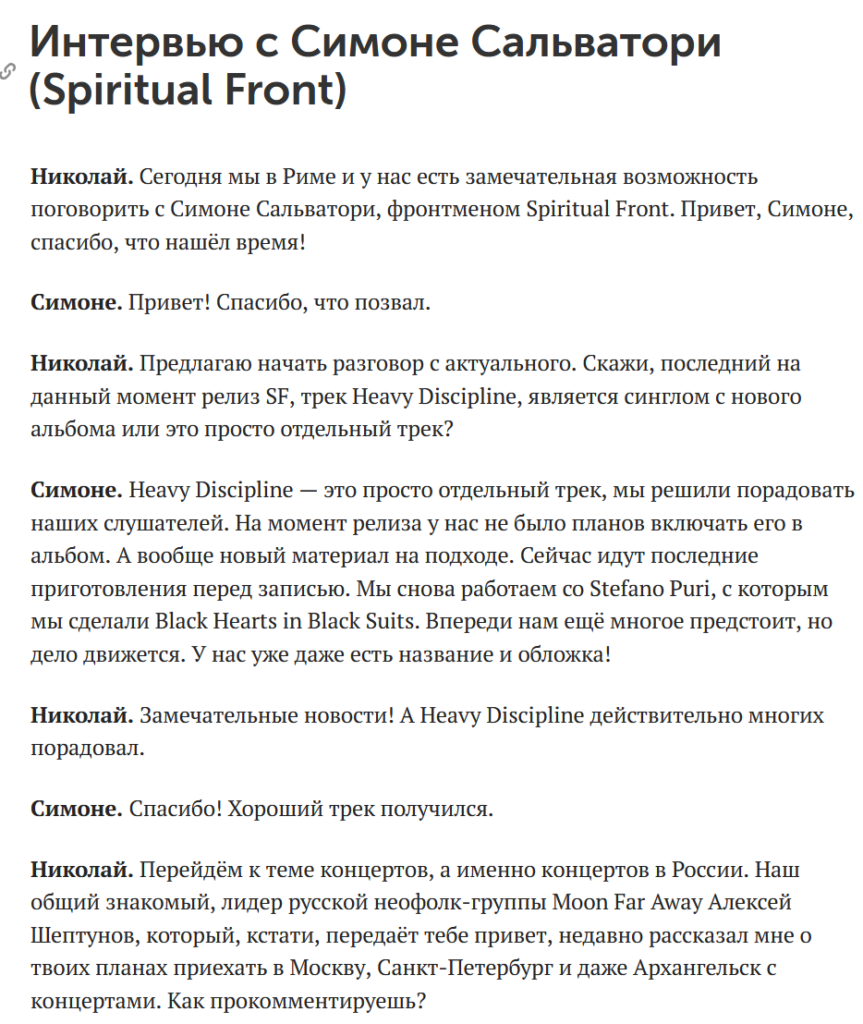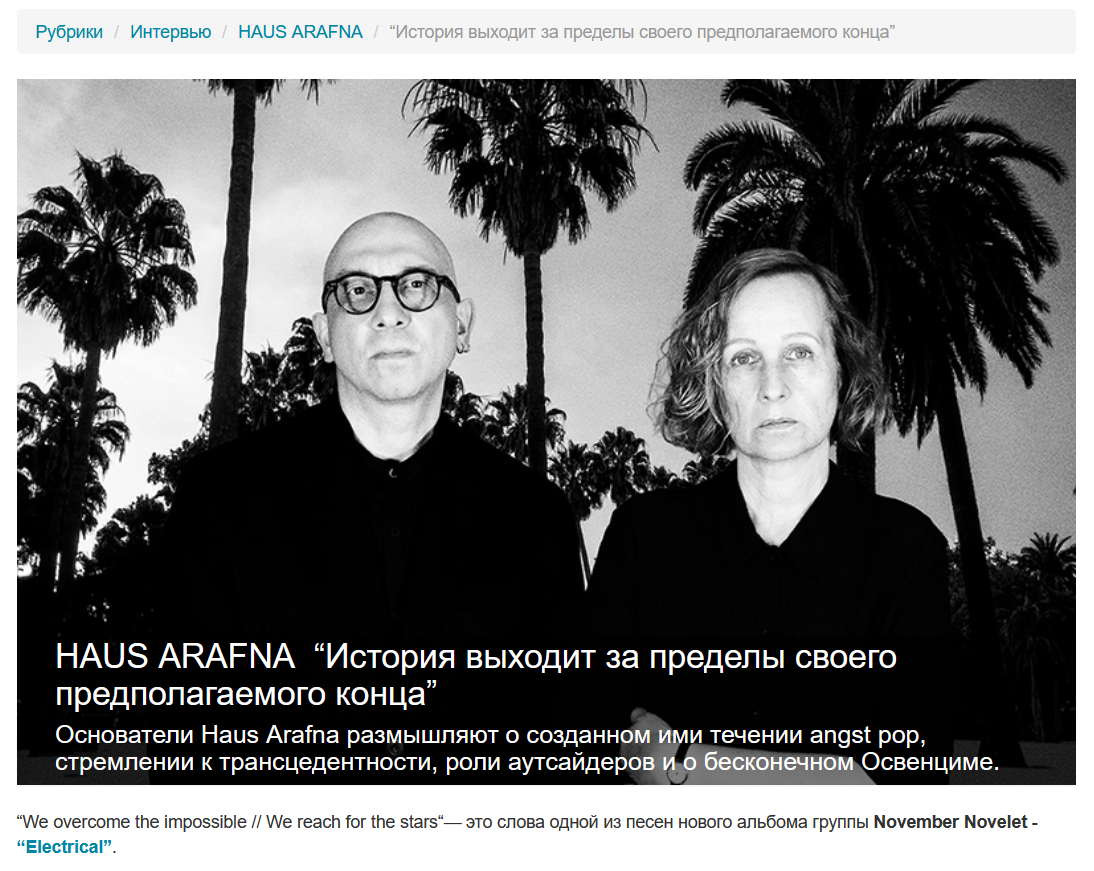
Industrial legends Haus Arafna and November Novelet join the international brigade of moskal useful idiots as they posted this interview on https://www.zvuki.ru/R/P/85615. Releasing more or less an album every ten years, and not giving any interviews, they decided to go forward with an interview for… a russian website. Claiming, according to their post on Facebook, that political topics are left out… Well, dear Mr and Mrs Arafna, isn’t giving one of your very rare interviews to a russian website a political and moral topic?
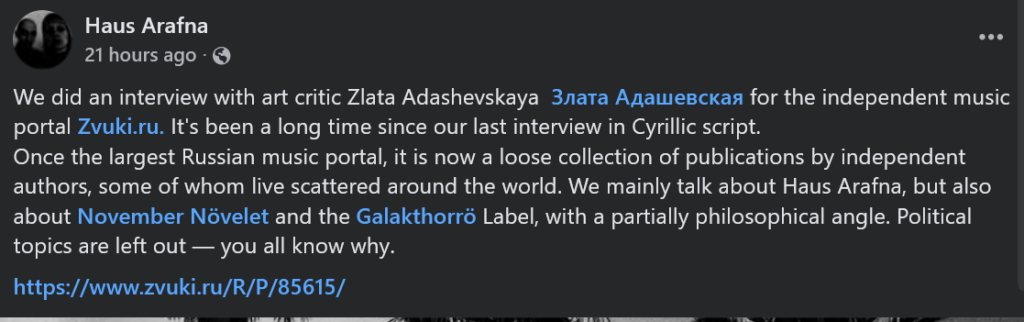
“Incidentally, we still ship to Russia if payment is possible, which is currently a problem.“
Here is the full version of it in english so you don’t have to visit that russian website
“We overcome the impossible // We reach for the stars” — these are lines from one of the songs on the new album Electrical by the band November Növelet.
November Növelet is the second project of Mr. and Mrs. Arafna, founders of the project Haus Arafna. For more than 30 years, high-voltage discharges of creative energy have sustained the life of their artistic hearth, which originated in the early 1990s.
The closest associations with Arafna’s music are more likely to be found in auteur cinema or literature than among the works of other musicians. Over the years, the gravitational force of their creative galaxy Galakthorro has gathered around the label a close circle of musicians inheriting a broad spectrum of genres : industrial, power electronics, harsh noise, ambient, synth-pop, coldwave… Mr. and Mrs. Arafna have закрепили for this formation the name “Angst Pop” — a code of ideological affinity rather than a musical form.
“Arafna cultura forever!” — this is the musicians’ motto, conspiratorially tempting one to become an agent of an alternative society with its own cultural code. Our conversation with Mr. and Mrs. Arafna encompassed reflections on the movement they created — angst pop — the striving for transcendence, the role of outsiders, and the endless Auschwitz.
Zvuki : In some interviews you said that one of the reasons you coined the term “Angst Pop” was a desire to separate your music from industrial, from which it grew. Industrial was a large-scale musical phenomenon of its time, rooted in rebellion against the mass industry, and sometimes against the modern world as a whole. How would you define the place of Angst Pop today, in the 21st century? What is the main difference between your activity and industrial?
The Arafnas : We didn’t invent the term; we simply borrowed it. The phrase “Angst Pop” originally appeared as a fragment of the lyrics of the song Walking on Dead Steps by the group SPK. Thus, the term was already known within industrial at the time, but without a concrete definition. Later, we developed it — perhaps in the very sense that Graeme Revell had implied.
For many years now, Angst Pop has been associated primarily with the Galakthorro label, which has become a symbol of this concept. Beyond Galakthorro, however, little has changed — Angst Pop has remained the same vaguely defined genre phantom.
The difference between Angst Pop and industrial lies in goal-setting : we no longer felt the need to make information accessible or to expose mechanisms of control in the sense of an “information war.” Throbbing Gristle, the archetypal industrial band, completed this mission themselves in 1981, since their “information war” lost relevance with technological progress that shook the world with new sources of information.
In this respect, we were from the outset more “pop,” since the foundations originally characteristic of industrial fell away — only angst remained.
Zvuki : Industrial subculture was highly politicized. Do you consider yourselves an apolitical formation?
The Arafnas : It depends on the point of view. The mere fact that we are giving you this interview could be regarded by some people as a political act — at least in the current situation, where any action is interpreted as a step in one direction or another.
But yes, we consider ourselves apolitical, because political orientation can impose temporal limitations on our self-expression. That is why we try to avoid political statements, especially everyday ones. We celebrate a timeless message : humanity’s striving for transcendence, for projecting itself beyond its own limits.
Zvuki : Since the definition of your music includes the word “pop,” I have to ask what you think of pop music itself. Do you see yourselves as its antithesis, or, on the contrary, as guided by it?
The Arafnas : What troubles us is the lack of expressive depth in much of pop music : the direct emotional connection with the author has been lost. There is a certain soullessness. Pop music is often created almost in an industrial manner by professional teams whose goal is simply to please as many people as possible. Boredom, randomness, and superficiality are built into it from the very beginning.
From this perspective, our music is oppositional simply because it is born in our own heads, by our own hands — the listener can feel us directly.
We have no producers, sound engineers, or separate composers and lyricists. Moreover, we not only produce the music ourselves, but also design our releases, organize the space, and handle distribution : any package you order from Galakthorro is shipped by us personally. Incidentally, we still ship to Russia if payment is possible, which is currently a problem.
Zvuki : Industrial never aimed to “please as many people as possible,” yet in the 1970s–80s it was far more popular than angst pop is today. Angst pop seems to be perceived as a European phenomenon for connoisseurs and aesthetes who seriously study independent music. Don’t you think it’s important for an artist to reach a wider audience and carry out some kind of cultural revolution?
The Arafnas : Ultimately, angst pop is just a label, and no one really cares about it. One empty phrase replaces another, resisting labeling. Of course, it’s a micro-topic within an already small industrial scene.
Any artist enjoys reaching a wider audience, but this should not become an end in itself. We do what we want, obeying a necessity for self-expression. Naturally, we hope to touch enough souls to become a focus of their “special interest,” since recognition is also stimulating. But we do not center our work around this.
If we were motivated solely by the desire to provoke a revolution in cultural development and declared it as such, it would be impossible to simply enjoy making music, and the chances of achieving that goal would be extremely small. The music would take on a strange, staged character. Moreover, much depends on external factors that an artist usually cannot influence.
Zvuki : Since the 1990s you have been promoting various musicians on your Galakthorro label. What criteria do you use to decide whom you want to work with?
The Arafnas : We have to like the music; it must possess a certain aura so that we can integrate it into our arsenal, and it must meet a certain level of quality. All these criteria, of course, are matters of our subjective judgment.
In addition, it’s important for us to communicate with the musician personally. To this day, we have released only artists who contacted us directly and expressed a sincere desire to shine in the cosmos of Galakthorrö. We usually do not work with those who have already released albums on dozens of other labels, or with those who send impersonal, content-less mass inquiries.
Zvuki : By the way, what exactly is “Galakthorro”?
The Arafnas : It is a variation of the medical term galactorrhoea (galaktorrhö). The term denotes the abnormal secretion of breast milk or milk-like fluid in the absence of pregnancy. The symbolic power of dysfunction and the finitude of our species on the one hand, and the ugly sound of the word itself on the other, perfectly embodied what we then considered a beautiful name for an industrial label.
In a broader sense, we also see in this word an intertwining of the galactic and the horrific (a phonetic resonance with the English words galactic and horror), paraphrases that are repeatedly reflected in the musical repertoire of our label.
Zvuki : Let’s talk about your own music released on Galakthorro. Haus Arafna was your first project, and a bit later you launched November Növelet. Both still exist today. How would you describe the relationship and differences between them? What can you do as November Növelet that doesn’t fit Haus Arafna?
The Arafnas : When we started at a young age, Haus Arafna was conceived as a very strict industrial/power electronics project, and we treated it as such. To reveal another side that corresponded more to our musical socialization within the wave scene, we created NN.
We believe that the principle underlying these two projects is still recognizable, but over time a partial merging has occurred — a natural development that we naively did not foresee in our youth. Perhaps we also didn’t expect all of this to last so long.
Zvuki : As far as I know, you are studio musicians and do not perform live. Why did you choose this format?
The Arafnas : We do not categorically exclude live performances, but we tend to move slowly and therefore always fear that preparing for a concert would slow us down even further — time that could otherwise be spent working on new material.
Besides, Haus Arafna’s music is difficult to translate into a live format. For example, the patching of our modular synthesizers cannot be fully reproduced.
Zvuki : Much of your music gives the impression of being inspired by personal dramatic situations, traumatic life experiences, and very specific mental states. You approach this without irony or detachment, often typical of groups with dark aesthetics. How did you arrive at this unique style? Is it easy to find inspiration for such depressively existential art over so many years?
The Arafnas : At the beginning, we mainly reacted to external influences and turned to the history of human destructiveness. Later, we involuntarily distanced ourselves from the world, so our driving force became a sense of unredeemedness, the origin of which we do not fully understand.
In this sense, everything is quite simple : we don’t need inspiration from outside — we draw from a source that springs within us. We feel fulfillment and depth when darkness touches us. Thus, the dark sound is also a life force, a reversal of emotion. The depressive, gloomy character becomes something inspiring and sustaining for us.
Zvuki : The history of human destructiveness that influenced your early work is still reflected in the name “Haus Arafna.” Not everyone knows that this was also the name of a ward in the Bethel von Bodelschwingh psychiatric complex, where the SS murdered mentally ill people. Your music also contains references to Nazi policy (“Holocaust,” “Swastika Kommando”…). How would you comment on Theodor Adorno’s idea that “after Auschwitz, any word that contains elevated tones has lost its right to exist”?
The Arafnas : This question reminds us that we should once again include the history of Haus Arafna on our website. At present, it serves merely as an individualized link hub.
We are not experts on Theodor Adorno and his work, but we believe that the Holocaust must always be taken into account. However, despite all the shock and grief it evokes, one must not forget how many other terrible sufferings existed before, exist now, and will exist in the future.
No suffering should be devalued by another, and the nature of humanity must not be denied. Our music, by its very nature, does not risk being mistaken for something that supports an illusion of beauty and harmony where something terrible is happening or has happened. In this sense, we probably remain faithful to Adorno’s way of thinking and are extremely far from trivializing a historical catastrophe.
The difference between his view and ours may lie in the fact that he regarded the Holocaust as an exclusively monstrous phenomenon, asking how such inhumanity could occur, whereas we tend to ask, “Why doesn’t it happen more often?”
Zvuki : Thinkers as different as Adorno and Jean-François Lyotard shared the idea that “after Auschwitz,” the writing of history is essentially interrupted by voices that cannot be heard, leaving a gaping silence and a need to invent new ways of describing the past. Auschwitz interrupts history because any meaning we assign to it betrays the victims’ suffering. While Adorno believed the only possible moral imperative was to think and act in ways that prevent its repetition, Lyotard believed it might be possible to invent languages that overcome this meaninglessness. Which position is closer to Haus Arafna? Can your art’s darkness be seen as an attempt to give voice to human suffering excluded from culture?
The Arafnas : Despite all their differences, both Adorno and Lyotard proceed from an extremely idealized idea of humanity. They imagine another, better human being and elevate this image — in a kind of metaphysical transfiguration — onto a pedestal. This approach is alien to us.
For both, Auschwitz represents a rupture in human history, a point where thought and speech are shaken at their foundation. Cruelty, even organized cruelty, appears to them as something alien — an exception that destroys the moral order.
For us, Auschwitz is not a rupture, but an extreme form of what is always potentially present. Absolute dehumanization, the limit of what can be said. We do not wish to relativize anything, but under certain social or psychological conditions, Auschwitz will always arise again. The gaps in historical narrative caused by unheard voices of suffering are part of human experience — a constant throughout history.
But we are not trying to consciously give voice to human suffering. Our music does not seek to moralize darkness — we simply look it in the face, because it is part of human existence.
Zvuki : Speaking of historical narrative, Arnold Gehlen diagnosed a state of “post-history” with its concept of “cultural crystallization” : all positions are defined, nothing moves anymore. An era of repetition, banalization, and secondary forms begins. Only ghostly reflections of great times remain : “Someone still sends old messages by telegraph, but… the power of electrical voltage has diminished many times over.” As artists and label founders, how do you relate to this thesis?
The Arafnas : Looking at artificial intelligence and its probable evolution, it becomes clear that the main driving forces of history and fundamental transformations are still ahead. Much will have to be reorganized and will change radically — socially, culturally, and technologically. At present, history is moving beyond its supposed end, and this will likely be far more destructive than the industrial revolution. So can we really speak of a “post-historical” state?
Arnold Gehlen was shaped by a kind of cultural pessimism that crystallized him as a personality. Like all of us, he was a person of his time, and his imagination apparently did not extend far enough to assume that new decisive changes could still occur in the future.
Nevertheless, his concept has not become entirely obsolete. You can still feel its truth in music. In a sense, everything does indeed seem to have existed already. Yet technological progress opens completely new possibilities — for example, perceiving music not only through sound waves, but bypassing hearing altogether via advanced BCIs, redesigning music as a cognitive experience with expanded parameters.
For us as artists — and even more so as “musicians” — all this is largely irrelevant. It would require a desire to be significant as the driving force of creation. In our case, it is rather an open process : an inner compulsion toward self-expression, without playing a specific role or fulfilling a defined function. It is wonderful if something new or unusual emerges, but that is secondary.
In the end, it is all a matter of perspective. We also make electronic music — something that existed long before us, for example with Kraftwerk — yet some listeners still find our music new, unusual, original, or meaningful for themselves.
Zvuki : According to Gehlen, modern society under the influence of science constantly places increasing demands on the individual, creating a need for “discharge.” Alongside life’s complexity, a sense of standardization grows due to the sharp decline in the importance of individual qualities. As a reaction, a thoroughly bureaucratized society longs for outsiders and nonconformists. From this perspective, do you see your position as outsider-like, and if so, do you enjoy it? Do you see your audience as a special part of society, or simply ordinary people seeking “release”?
The Arafnas : Art, literature, or music often arise from the artist’s insecurity in the world. He does not quite fit into it — and the world cannot quite “fit” him. We share this perception. In this sense, we do occupy the position of outsiders.
We derive no pleasure from it, because in many situations it means not freedom, but the necessity of building a façade. Starting with something basic : we cannot openly tell everyone what we actually do. Such questions arise when meeting new people outside our subculture, for example at a birthday party. It is a paradox : we would like to reach more listeners, but not just anyone, and not by that route.
We are not sure that a longing for outsiders and nonconformists as a reaction to a standardized, bureaucratic world truly exists. Still, the idea of a need for “discharge” as a response to overload in a constantly changing environment seems plausible.
We do not know what our audience is like in this respect, and we have never seriously thought about what function our art should serve for them — at least not in any overarching or intellectual sense. We simply hope for something ordinary : that the music touches people and gives them life force.
Zvuki : Whom would you name as your favorite thinkers and artists? Can your work be said to be directly connected to them?
The Arafnas : Beyond our shared roots in the wave/gothic subculture, our individual sources of inspiration differ quite strongly. But we both — which is rather amusing given that we are saying this for a Russian magazine — once read Fathers and Sons by Turgenev together, as well as Crime and Punishment and The Brothers Karamazov by Dostoevsky. We read them aloud to each other, taking turns — as was once customary.
In the last of these novels, there is the episode “The Grand Inquisitor,” which at one time inspired us to create one of the tracks on our album You. Such inspiration is more the exception than the rule, but it is an example of the direct connection you asked about.
Zvuki : What releases has Galakthorro put out recently?
The Arafnas : Our new November Növelet album Electrical (LP/CD/digital) has just been released, along with a video for the song “Möwen.” In addition, there is the new Haus Arafna single The Spring Heals — a seven-inch digital release — as well as several other works by different artists on our Galakthorrö label.
Zvuki : What are your future plans?
The Arafnas : To remain unchanged.